On the Luštica peninsula the land comes first. Olive terraces and drystone, the dry Mediterranean scrub, a coast worked and left and worked again for as long as anyone here can account for.
Along one bay of it a town is going up. Early, before the work begins, the two things stand beside one another without much comment — the old ground, and the new streets laid across it, some finished, some still drawing themselves in the dust.
The peninsula has been inhabited since ancient times: small villages, fortifications near the mouth of the bay, olives and salt. What is being built now does not pretend the ground was empty. But it is being built, so far as such things go, all at once and whole — and that is the unusual thing.
The essence
It is easy to reduce Luštica Bay to villas, a marina and a golf course. That is the least interesting part of it.
What is unusual here is not that the place is expensive. It is that a whole town has been drawn in advance — its shape, its streets, its harbour, and an idea of who might live in it — and then set down on a coast that is anything but new. Most settlements accumulate. This one, by its own design, was planned.
It helps to be clear about a thing often confused. Luštica Bay is not the Luštica peninsula. The peninsula is an old and inhabited landform, the southern arm at the entrance of the Bay of Kotor; Luštica Bay is a recent development on one part of it. The names are close; the two are not the same. Perhaps the most honest way to hold the place is as a question rather than a verdict — what happens when a town is imagined complete before it has been lived in at all.
A town planned in advance
Most places on this coast were built slowly, house by house, one generation correcting the last. Luštica Bay, by contrast, was drawn first and built afterwards.
The land — reported at roughly six hundred and ninety hectares — was planned as a single composition: neighbourhoods, a marina, a golf course, hotels and a town centre, arranged before the first foundation. Building began around the middle of the last decade and is intended to continue, in phases, toward the end of this one. To design a town whole is an old ambition, and a difficult one. It can offer a coherence the accreted town rarely has; it can also carry the risk every planned place carries — the quiet of somewhere decided rather than grown, where the life is expected to arrive and fill a form already waiting for it.
Whether that produces a town in the full sense, or a very careful likeness of one, is not a question that can yet be answered. The place is too young. It is fair only to say that the wager is an unusual one, and that it is being made in the open.
The town today
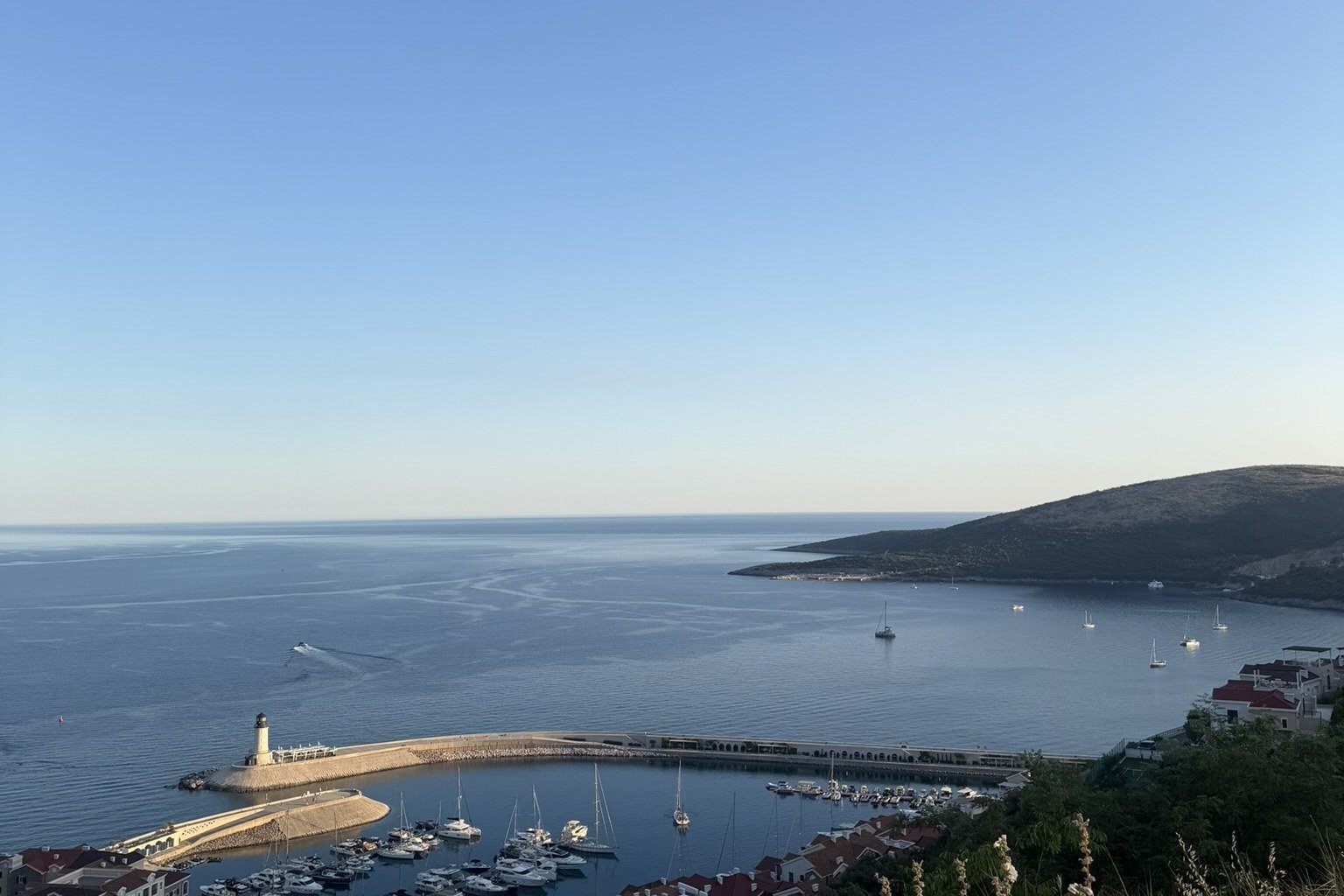
What stands on the peninsula today is less a finished resort than the beginning of a small town.
Behind the water a handful of quarters have taken shape — Marina Village among the first, gathered around the harbour, then Centrale, planned as the denser heart with its square, with further neighbourhoods intended above them on the slope. The marina holds the centre of it: reported at around two hundred and twenty berths, on Trašte Bay, with a second harbour planned. On higher ground, an eighteen-hole golf course attributed to the designer Gary Player is being built in stages; its building permit, issued in 2014, is reported to have been the first for a golf course in Montenegro. It is laid, the developer says, so that the sea is in view from much of it.
There are hotels of different temperaments. The Chedi, the town's first, opened in 2018 and presents itself as quiet rather than opulent, in the manner of its house; a second, Centrale by Angsana, has since opened; a Ritz-Carlton has been spoken of for some years and, at the time of writing, is not yet built. Taken together they are less the point than the evidence — the parts by which one can begin to see whether the whole is becoming a place people inhabit, or a season they visit.
Capital and ownership
Luštica Bay is built by a company, Luštica Development. By the ownership on the public record, Orascom Development holds the greater part of it — about ninety per cent — and the Montenegrin state the remaining tenth: a stake in the venture, not control of it.
Orascom has raised places of this kind before, on open land elsewhere — El Gouna on the Red Sea, Andermatt in the Swiss Alps — whole towns planned in advance and delivered as a single asset. Luštica Bay is another of them, on the Montenegrin coast.
For a small state, the arithmetic is plain. Montenegro gains investment at a scale it could not easily have raised on its own, and a name that carries beyond its borders; in return, one of its most recognisable shores is developed as a partnership in which it is the minority partner. That is the shape of the bargain, whatever one makes of it.
The peninsula beneath
The ground beneath the town is much older than the town, and it is worth pausing on.
The Luštica peninsula has been lived on for a very long time — worked for its olives, its salt and its stone, marked near the bay's mouth by nineteenth-century coastal fortifications, dotted with small villages, Rose among them, that kept the slow economy of a Mediterranean shore. A new development inevitably stands in some relation to that older ground: the landscape lends it a depth it has not itself had the time to acquire.
But it is too easy to call that borrowing and leave it there. A new town may take from the old ground, or it may add a layer to it; it may restore patterns of building the coast already knew, make the landscape more legible to those who arrive, and pay for the infrastructure that keeps it alive — while, at the same time, drawing commercial value from an identity it inherited rather than made. Which of these best describes Luštica Bay is the real question the place poses, and it is not one to settle here. It is better left open than answered too soon.
In context
To place Luštica Bay correctly, one has first to say where it is not.
It lies in the municipality of Tivat, on the outer, Trašte side of the peninsula — not in Herceg Novi, an error that creeps in from the peninsula's wider geography. It sits beside the Bay of Kotor, and beside it is the precise word: the bay is under UNESCO protection, and the town is next to that protected area rather than within it — a distinction that matters. Boka, it is worth adding, is not a fjord, as it is often called; it was formed by the drowning of river canyons, not by ice — a warm sea enclosed by mountains, not a northern one.
Around it all is Montenegro: a small and young state, a candidate for the European Union, still learning to read its coast as something more than a summer. Tivat, quieter in reputation than Kotor or Perast, has an airport about a quarter of an hour away, and has changed a great deal in a short time — Luštica Bay among the reasons.
Significance and dispute
It would be too easy to write of Luštica Bay only as promise.
To build a whole town at once, beside a protected bay, holds a tension that does not simply resolve: between the coherence of a single plan and the openness of a landscape valued, in part, for not having been planned at all. The development's claims for itself — a light footprint, described as covering only about a tenth of the land, an approach it calls careful of its setting — are the developer's own, and are better treated as attributed than as settled fact. So too the figures for what has been invested, and for what a property here might return.
One confusion is worth ending plainly. Owning property here does not, in itself, grant a passport. Under legislation that took effect in 2026, it can be a basis for a temporary right of residence — not citizenship; Montenegro's earlier programme of citizenship by investment closed in 2022. The two are often run together, and should not be. Anyone acting on this ought to take current professional advice rather than an editorial page.
If, early, before the machines start, you stand where the new streets meet the old terraces and look out to the water, it is hard to say in a single word what Luštica Bay is. A town, a plan, an investment; an attempt to make coastal life whole, and to make it in advance. Probably a little of each — with one thing the older places here do not have to carry: it is being judged before it is finished, a place designed before it has had the time to become itself.