The placid water of the Boka Bay meets mountains. Squeezed between them, solid stone makes a city. The procession of cruise ships and crowds replaced the succession of institutions and epochs. The narrow frame of walls defines a chess game of a town that has made its name and tradition.
By morning, sunlight reaches into the narrow streets of the Kotor Old Town as they steadily fill. Voices resonate in passages that, hours earlier, stood empty. By evening, much of that movement has receded. The stone remains.
These are two faces of the same place: one is passed through, while the other has accumulated. The former is immediately visible; the latter asks for more time.
The essence
It is easy to reduce Kotor to its walls, squares and the arrival of ships. They make up the well-known image, but they do not explain the city.
Within the massive walls are historical buildings in which seafaring, trade, and diplomacy were decided upon.
If the story of Porto Montenegro is one of the transformation of the former naval base, and Luštica Bay one of the conception of a new city, the story of Kotor is about the inner coherence. This coherence was not planned or imposed. It emerged. In Kotor, every important building is a reflection of its time; every time brought its own political and developmental direction.
What constrains Kotor, it shapes it. In the narrow space of the massive walls, between the mountain and the sea, a civilization was kept for centuries. Kotor was both Latin and Slavic, defined by Venice, under whose rule it placed itself in 1420. It was also a part of Byzantium, an autonomous city in medieval Serbia, and from 1391 to 1420 a free city of patrician families, Romanesque institutions and its citizens.
An entire civilization of Slavic and Latin influence today seeks to present its own direction before a procession of the whole world.
Layeredness in Kotor: the contours of a civilisation
The array of walls with fortified posts climbs up the slope. Seen from the top, the Fortress of St. John guards the docks, the whole Bay visible from there. In ancient times the settlers recognized the narrow strip protected from behind by the mountain. What was in the beginning settled has become a town. Stone rises from the sea.
St. John does not only oversee the town. It towers over the triangle of walls within which the institutions, patricians and citizens have devised coherence and their unique social order. The walls have outlived the civilization they had sheltered for centuries.
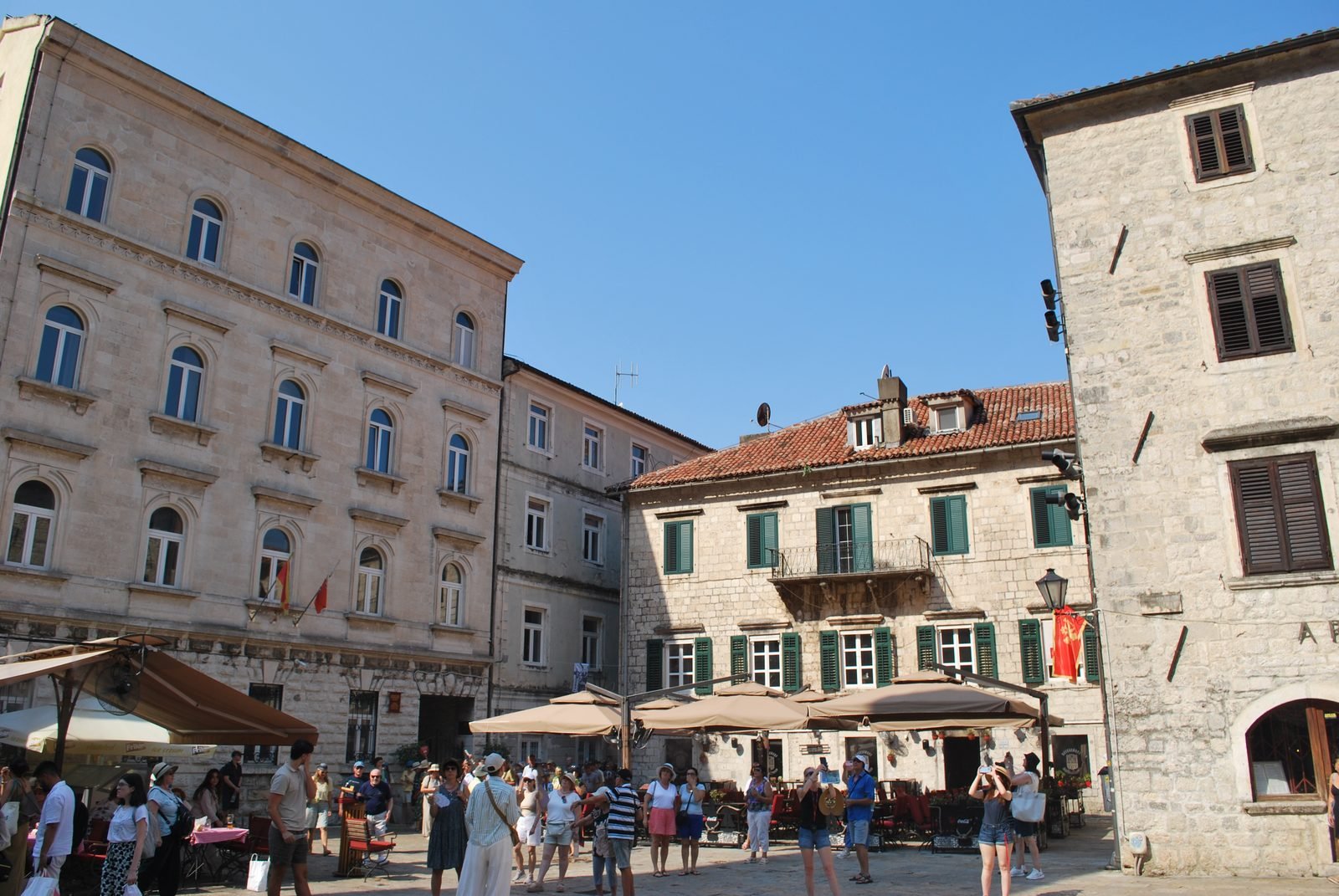
Architecture of constraint: the walls
In 535 AD, the Byzantine emperor Justinian erected the first fortress over the town; the defense system of the town was developed by Constantine VII Porphyrogenitus in the 10th century and the Venetians. The firepower and cannons achieved significance by the Renaissance; the Venetians built the bastions and cannon towers by the 15th century. This made Kotor unrivaled by Ottoman attempts to conquer.
The walls did encompass the town—not only for its defence. They determined how the town was accessed and passed through. As Cvito Fisković, an art historian who documented the heritage of Boka Kotorska, states, three out of four gates of Kotor are joined within the town by longitudinal and transverse streets which, though irregular, recall the cardo and decumanus of Roman towns, while the fourth is reached by a staircase up the hill.
The Roman plan of the town outlasts the centuries. It still shapes how the town is walked through.
The Venetian defense system of Kotor entered the UNESCO list as a part of “Venetian Works of Defence” (2017), incorporated in the Venetian defense doctrine Stato da Mar.
Every century, the stone embraced a new form.
The anchor of faith: the Cathedral of St. Tryphon
According to the writing of Pliny the Elder, Kotor was the town of Roman citizens, though the center of Roman Boka Bay was in nearby Risan. Kotor came under Gothic rule when Roman Dalmatia fell.
The rise of Kotor began with Emperor Justinian. It came under Byzantine rule during his Reconquista. The small town in Boka Bay took part in a significant historic turning point — an attempt by Justinian I to restore the Roman Empire.
Despite the lack of significant records on Byzantine rule in Kotor, it should be noted that the Church existed and played an important role. Bishop John of Kotor was one of the signatories of the Second Council of Nicaea in 787. Among the delegates of the Christian Church, the representative from the small town of Kotor took part in it.
By attending the Council, Kotor demonstrated that it had been a significant cog in the order of Christian ecumene. The town represented an important geopolitical aspect as a dispute between the West and the East on the division of clerical jurisdiction was simmering.
After the Council, according to tradition, around 809, the town of Kotor acquired a new patron saint. An esteemed citizen of Kotor, Andrea Saracenis, around 809 traveled to Constantinople and bought the relics of St. Tryphon, in whose name a small chapel would be erected. According to the legend, seamen were on their way to Dubrovnik with the relics, but a storm or lightning redirected them to Kotor.
On the relics of St. Tryphon, Andrea Saracenis built the first, small church. On the same site, one of the most famous symbols of Kotor would emerge — the Cathedral of St. Tryphon.
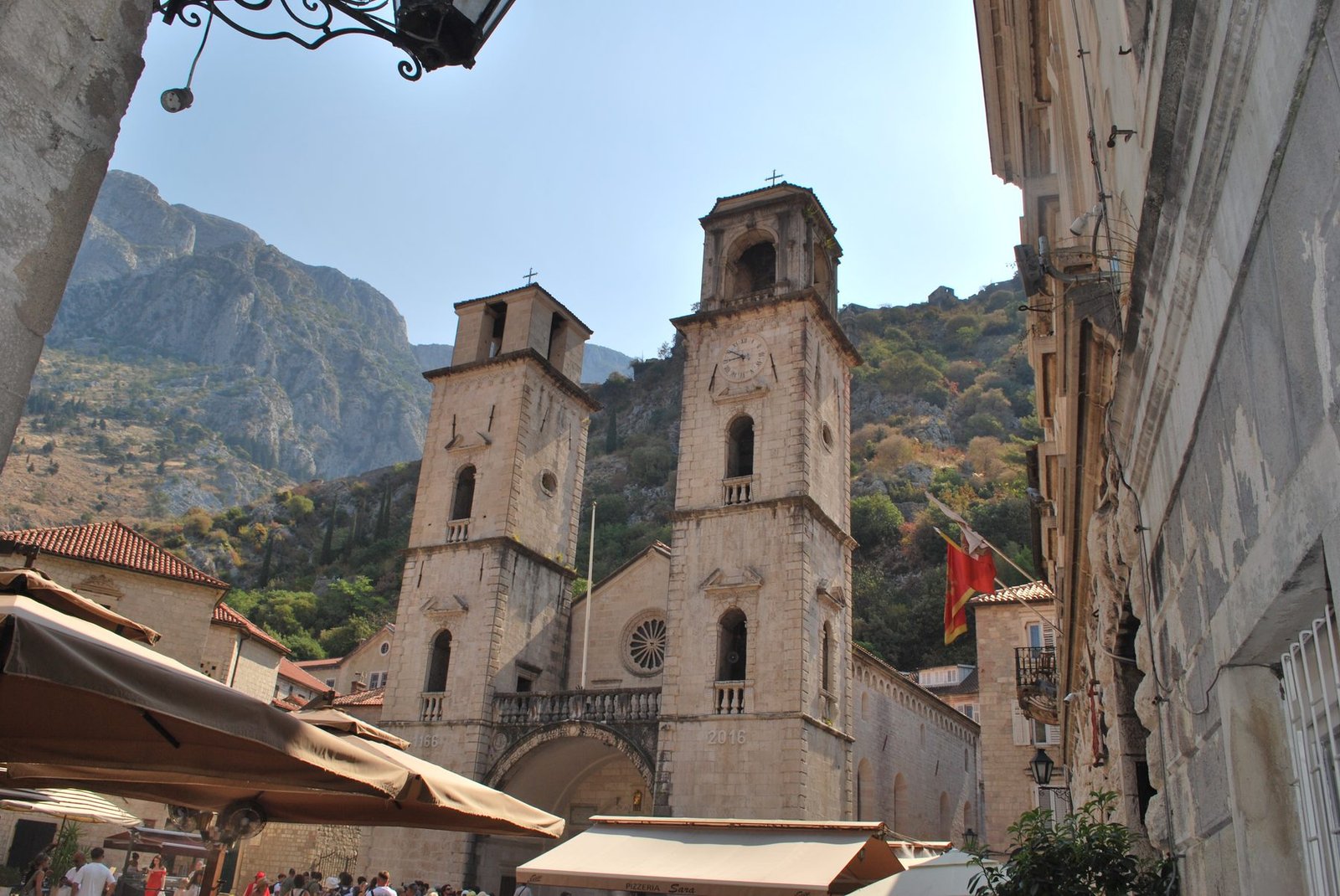
In 1124 the Great Council of Kotor approved the construction. By 1166 the new Cathedral was consecrated, a masterpiece of Romanesque architecture. With thick walls and semi-circular arches, typical of Romanesque, a three-naved basilica was constructed. It is the oldest cathedral in this part of the Adriatic.
The Ciborium, from the 14th century, depicts scenes from the life of St. Tryphon; it combines Romanesque and Gothic elements and is made of the red stone from the Boka Bay.
The Baroque bell towers were built after a devastating earthquake in the year 1667. Because of the economic crisis, the left bell tower was never finished and is set two metres lower than the right one.
The three-naved Romanesque basilica, modest and austere, is presented with the gilded silver reliquary bust of St. Tryphon. Dating from the time of Kotor’s goldsmiths, the Golden Pala is set above the altar. It is a gilded altar dedicated to the Virgin Mary, St. John, St. Tryphon and sixteen more saints, as well as to Jesus. The Cathedral was enriched with Byzantine frescoes that were lost over time.
The stone on the square has remained. The Cathedral has accumulated traces of time. Still, it bears something less permanent than the stone. What it bears — belief, discipline and scripture — is preserved only if taught.
The continuation of an institution: the Boka Navy
Every year on 3 February, the Day of St. Tryphon is celebrated. Since the Middle Ages, the festive procession has been passing through the city. Sailors join it. They keep tradition and maritime practice, gathered in the famous Boka Navy.
The festivity begins with the Kolo of the Boka Navy, then with the holy mass, and continues with the procession through the town. The traditional dance is performed by sailors clad in traditional uniforms of the Boka Navy. Before the mass, the chosen boy, in the uniform of the admiral, recites the praise to St. Tryphon.
The Boka Navy was founded as a guild-based organization, an association of seafarers with religious origins. Its role was to advocate for the rights of seafarers and to care for their offspring. It had the role of a guild and a form of a merchant association of a medieval city. Much of the trade was done on the ships. To pass the structure through time required a guild.
The Boka Navy holds the title of the Brotherhood of the Sailors of St. Nicholas, named after their patron St. Nicholas, the protector of sailors and seafarers. It had a ritual character. On the Festive Day of St. Tryphon, the Venetians would symbolically, for three days, hand the rule over the town of Kotor to the admiral of the Boka Navy.
Apart from the Navy, there are other maritime guilds that made the ship construction of Kotor famous. But, alongside the Church, the Boka Navy is the oldest institution in Kotor, with traces from the 9th century.
Today, the role of the Boka Navy is both memorial and active. The Navy trains the sailors in the kolo, accompanies the celebration of St. Tryphon, publishes and revives the tradition. It joined the UNESCO list of intangible heritage in 2021.
An institution from the 9th century — one of the oldest maritime brotherhoods in the world — it bears the anchor in Kotor as deep as the Swiss Guard holds in the Vatican. Yet its name reaches less. What has no fixed shape can outlast time. The Navy outlived its functions by acquiring new forms each time.
The seafarers paved their ways through distant waters. Their fame reached the walls of the world metropolises of the time, where decisions were made. One of them, Luković, achieved the status of the Austrian nobility, titled Luković de Ascrivio.
The significance of the Boka Navy is immeasurable and layered. The Navy gathered people of different backgrounds, social statuses and worldviews. What connects Kotor and the Navy is layeredness. The heritage is best understood from many sides.
Merit and nobility: the patricians of Kotor
Kotor, during the Middle Ages, freely put itself under the rule of Venice in 1420 as a Mediterranean city-commune — with its legal system, Council, Church and other institutions that preserved their autonomy. Besides the likes of Dubrovnik or Venice, the order of Kotor was based on the Statute of Kotor, adopted in the year 1301. This social environment and city culture became the foundation for the social layer of patricians — a nobility with global reach.
The patricians are not only related to the rule of Venice. The Bizanti family from Kotor presented the town with many seafarers and professors, as well as the famous judge Nikola Bizanti, who led the reconstruction of the Cathedral after the earthquake of 1667.
During the Middle Ages, the rise of the Kotor family Buća was significant. Nikola Buća was the court treasurer, responsible for finances at the court of the Serbian emperor Dušan the Mighty. For their services the family received their nobility. A representative at the papal court, Trifun Buća was a famous merchant and diplomat. From the French King Charles de Valois he received permission to place the French lily on the family coat of arms. This rise and influence of the Buća family is distinguished by ties with Dubrovnik. They traded and lived in both cities. Their path follows the shore, and the shore paved the wealth among the cities.
As said, by the decision of the Great Council, Kotor came freely under the rule and protection of Venice in the year 1420. This paved, for the patricians of Kotor, the way of stability, trade and economic relationships across the Europe of the time.
A citizen of Kotor, Andrija Paltašić, is one of the first printers in Venice. The Pima family also deserves a mention, whose members were famous humanists of their time. The poets Bernard and Jeronim were poets laureate, presented with the honoured laurel wreath. Their family coat of arms, placed on the portal of their palace, is decorated with two angels.
The autonomous Kotor presented Europe with families and esteemed citizens who had contributed to European affairs in Venice, Padua, Rome and Avignon. At the beginning, patricians were not born. Their status was earned. Kotor knew much about meritocracy. Tradition passed it through generations.
The households of meritocracy: the palaces of Kotor
The patrician palaces of Kotor make up the architectonic coherence of Kotor. It is another layer visible in stone. They survived many inhabitants, architectural interventions, and the natural circumstances themselves. Gothic and Romanesque paved the way to Renaissance and Baroque — shaped by human hands and by what nature imposed.
On the Square of Flour there is the palace of the Buća family. It evokes the Gothic architecture of the early 14th century. The palace was restored after the earthquake of 1667. The palace holds massive size, but is distinctively modest. The original Gothic traces did not outlast the reconstruction, though the Buća coat of arms is visible today.
The palace of the Bizanti family (14th century) is done in Romanesque-Gothic architecture. The earthquake caused the interventions that brought Baroque. Nikola Bizanti, an esteemed judge, led the reconstruction of his home and his town. Across Europe, Baroque joined religious renewal. In Kotor, after 1667, it accompanied the rebuilding of the stone.
Next to the Cathedral of St. Tryphon stands the palace of the Drago family. The northern part of it, and the windows and portals with their decorative carved-stone elements, are distinctive examples of Gothic architecture. The 17th century brought Renaissance-Baroque architecture. The coat of arms of the Drago family contains a dragon, and the palace belonged to the family until the 19th century.
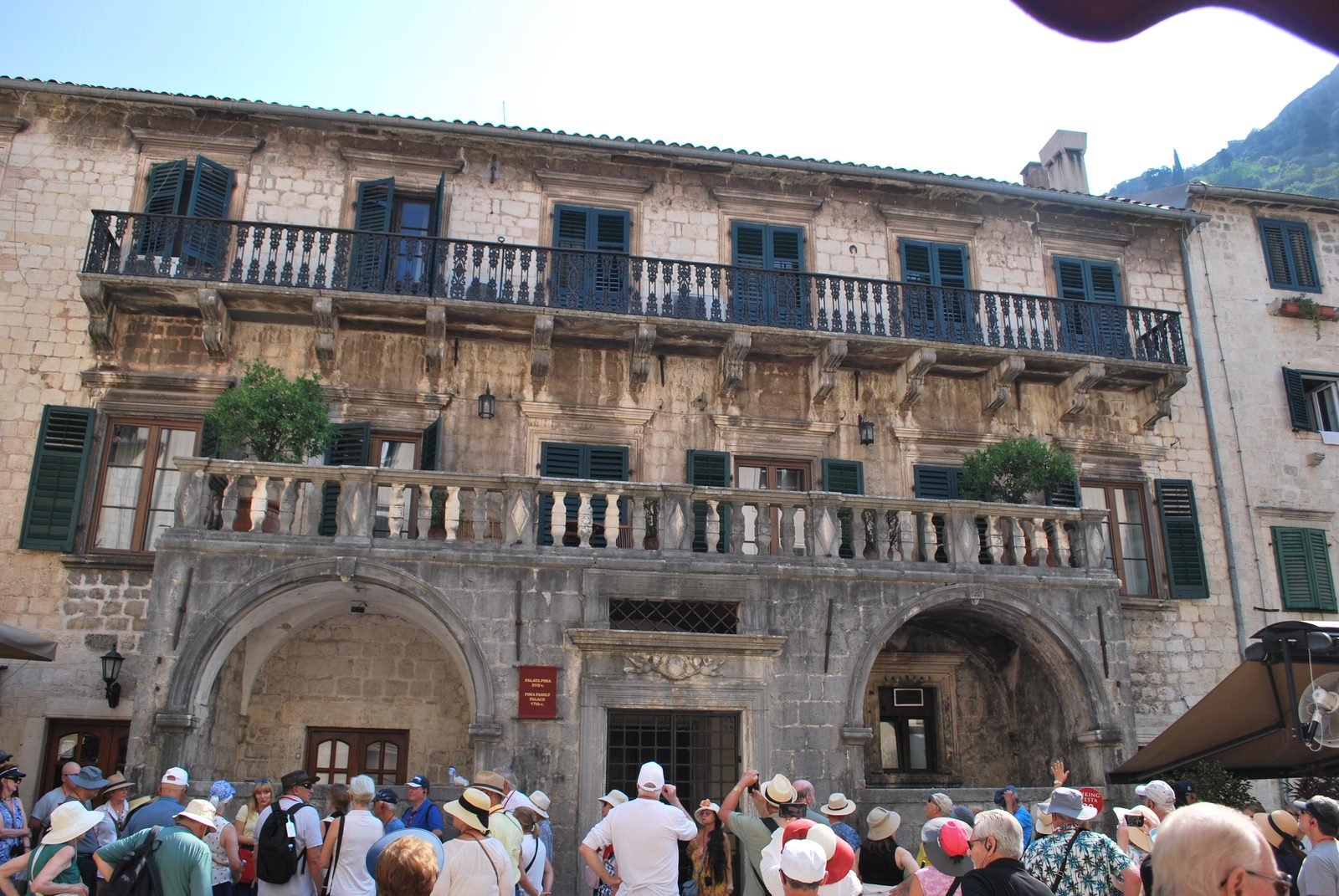
The palace of the Pima family, from the 17th century, is the best preserved. On the Square of Flour, it epitomizes the Renaissance-Baroque architecture, with two angels from the coat of arms looking over the square.
Inhabitants of the palaces accumulated massive cultural heritage, power and wealth. What survived are their homes, as most of the descendants remained unknown, if any are living today. Palaces survived their owners and the town they belong to. Kotor brings them visitors every day. Then they remain, until their visibility brings new context to Kotor too.
In context
To understand Kotor, it should not be constrained to a famous tourist destination.
What the paper and the stone accumulate cannot be seen by the bare eye. Kotor is cherished for its mountains, the sea and the walls, but not for the civilization they hold. Whether that is good or bad, the stone remains silent.
Nothing told has remained unknown, but the public discourse paves another direction — a more shallow one, more modern, in accordance with the time and the procession of ships. The State of Montenegro can provide Kotor’s civilization with a frame of visibility and legitimacy; Kotor can present the State with the substance of statehood, culture and diversity.
Kotor, contrary to Porto Montenegro and Luštica Bay, has not been created by a plan. It had been there even before modern Montenegro acquired its current form of statehood. The surroundings of Kotor determined its development; religion and the sea gave it its layeredness. As empires succeeded one another, the town adapted accordingly.
The political and cultural multi-layeredness gave the city the contours of a civilization, and the determined direction gave it endurance and significance beyond the mountains and the walls.
Significance and dispute
It would be simple to present the tourist Kotor as a historically important town.
Its depth and attractiveness are coherent with the procession of visitors and cruise ships. Tourism holds a great share in the national income of Montenegro. To resist that challenge is not easy. The economy and development are subjected to it.
During one day Kotor may accept more than 5,000 tourists. On its streets all the languages of the world can be heard. How it impacts the lives of the local population is the conclusion to be made by those living in Kotor.
The city, whose streets were designed for intimacy and silence, is coping with numbers it was not designed for. The real estate market in Kotor has flourished. Many living units have been turned into apartments for rent. Many have accumulated substantial capital. From the outside it seems to be a good deal. The significance and beauty have acquired usable economic value. The conclusions are drawn when the season is over and the stone, for the moment, remains alone. It is better to leave this question open than to make a conclusion too quickly.
Migration of local population, the adaptation of ecological infrastructure and circumstances amid the huge number of visitors is not a novelty on the Adriatic. Dubrovnik and Venice, or further afield Nice and Cannes, adopted specific policies that have brought a new reality in the cohabitation between citizens, the environment and tourists. Some plan to ban cruise ships from the cores of the cities; some have raised tourist taxes.
What comes out of these measures in the cities mentioned is provided with the European legal and normative framework. For Kotor, the town of a layered historical civilization, that legal and normative framework is yet to come. Till then, the state of Montenegro enforces state legitimacy and laws and is obliged to protect the environment, the town and, most importantly, the citizens living within the walls.
If, in the morning, before the procession of visitors, you happen to stand in front of the stone of Kotor, you can anticipate the heritage accumulated within the walls. Kotor does not ask for legitimacy but for better legibility. The state of Montenegro, through its institutions, enforces the laws and demonstrates statehood; Kotor, through its continuity, strengthens that statehood. Both of them seek better recognition. The small state seeks its completeness, and the town asks for the recognition that does not end at its walls.