Two islets appear in the Bay of Kotor. Viewed from the shore, they are legible to few. A miniature autonomous community of sea captains, Perast produced its own architecture, school and church from the abundance of the sea — a church set into the water.
As walls shaped Kotor, so the sea steered Perast — daring interwove knowledge into the norm of survival.
Today, this fruit of the Baroque helps build the path of Boka and Montenegro towards luxury. But the notion of continuation is just to be assumed.
There are two mirrors of the same place. One echoes the past — of sea captains, Venice and nobility; the second assumes the modern opulence and upmarket hospitality. The end they meet is the same stone.
The essence
It is easy to assume that the sea helps Perast shape its development and significance.
On the narrow strip of shore, constrained by the sea, ensued an extraordinary concentration of history, architecture and initiative.
It is a town of sea captains, shaped by them, and of the heritage significant even amid the world events of the time. Their city lasted as long as Perast created a legacy and progress that it did not need to explain.
The sea helped Perast's captains reach empires and influence them, and the sea brought back to Perast its call. That call determined the form of the stone. The palaces, the maritime school, the churches — the nobility and captains of Perast needed them and created them. A miniature town flourished.
What echoes the past is resilience. Their resilience had its arena. When Venetian rule receded, Perast handed its call to others. It did not decline — the town became visible.
An extraordinary coherence did not diminish. What ceased is its resistance to being judged. What time overthrew was made by science, courage and nobility.
In the 20th century, the fate of Perast was in the hands of others. Royal Yugoslavia recognized their right to hold their marvelous possessions in the miniature town, but the economy was no longer in their ships.
Communist Yugoslavia determined Perast to be what is less today. A peaceful, beautiful cradle of luxury gathered the intelligentsia of Yugoslavia at the time. Captains became citizens of a country that recognized the legacy formally, opening the Museum of Perast in the Bujović Palace.
Unlike Kotor or Herceg Novi, Perast was spared from industrialization. The stone remained untouched. Behind it was the state that officially protected it.
In contemporary times, the stone faces a new role. Protected by recognized institutions, its form remains unaffected. The baroque town of sea captains is adored by many. But when the crowd withdraws, the town is not left to stand. Foreign capital plays a vital role in its preservation. Though Perast has faced depopulation, many buildings have new owners.
Exemplarily, Rixos opened its hotel in one of the palaces in Perast. Luxury brought from abroad recognized the layers it wants to build upon.
What Perast created now sits in the museum. The drive it pursued, we can only assume. The sea that constrained Perast now saves it.
The fulfilled norm
In Perast, even before it was settled, the sea and stone had predestined how it would be made.
A town exposed to the sea
Natural elevation precedes its linear form. From the palaces and institutions set along the shore, the slope climbs 873 metres to the peak of St. Elijah; beyond it, the terrain ascends over 1,200 metres within Perast's own boundaries. The town had no hinterland to expand into — it remained on the narrow slope between the hills and the sea.
Along the sea runs a single road — one the Kotor-born historian Gelcich, writing in Italian, attributed to the Roman coastal route that once linked Perast with Risan, Orahovac, Dobrota and Kotor. What the sea imposed took different forms through the layers of time: two autonomous maritime communities of the inner Boka — Kotor and Perast — one drawing its coherence within its ramparts, the other left forever exposed to the sea.
Beneath St. Elijah, the Fortress of the Holy Cross was erected. The buildings and palaces themselves joined the defensive scheme, together with about a dozen adjacent towers that protected the town. The linear town built no walls; it relied instead on its sea captains, its warships, and its prominent houses that turned into fortresses in their own right. From high above, the Fortress commanded the Strait of Verige, the entrance to the inner bay. According to tradition, the name Verige evokes a chain once stretched across the strait to keep invading ships from pressing deeper into the Bay.
Civic order of sea captains
Perast's civic order was not unusual for its time, but it was infused from within.
A dozen casate — though Gelcich cites thirteen — formed the governing layer of Perast. A casata was a clan: a family, or several families, gathered around interest, bloodline and privilege. Each was headed by a capo; the community itself was governed by a captain and a council of the twelve casata heads.
In matters of dispute, Perast followed the Statute of Kotor; alongside it, it kept a statutory book of its own — the Green Book. A standing representative resided in Venice, and from time to time three deputies went there to hold Perast's privileges firm.
What Kotor conceived within its walls, Perast accumulated through its bloodlines. The order was infused from within long before it was framed from without.
The norm of the sea
Exposure to the sea defined who would leave — for service, for adventure, for a privilege won abroad — and the will to go, and to return, is what sustained Perast.
The wealth of the sea evokes the norm — to survive and inscribe a perennial mark upon the narrow strip. What it predestined is the constant pursuit and exceptionalism. What it gave birth to is an extraordinary concentration of achievements that can be seen in the layers of the miniature town of its sea captains.
From building and commanding the navy of Peter the Great's Russia to becoming fedelissima gonfaloniera, one of the most loyal Venetian subjects, Perast exercised the resilience and determination of people — a fulfilled norm of duty to endure, eventually return and have a hold in the arena in which their town was set.
At the birth of the Russian fleet
Peter the Great travelled north to learn how ships were built in Holland's shipyards. His noblemen were sent south to Perast to learn how to command ships — to a distinguished captain, Marko Martinović.
At the request of the Venetian Senate, a group of Russian maritime cadets (different sources cite 16 or 17 noblemen) were sent to Perast in 1698 for maritime practice. For the service of a maritime tutor to young Russian cadets, Martinović was honoured with a lifetime pension. The norm of mastery took shape in a captain from a community whose members had to give everything to the sea. Perast was, by tradition, named “the cradle of the Russian fleet”.
In the museum of Perast, a restored picture of documentary significance “Marko Martinović teaches Russian cadets” can be seen. The picture dates from 1711.
What brought Russian cadets is not only the knowledge taught in Perast or Venice, but also cultural bonds. The envoy of the tsar, Count Peter Tolstoy, in his travel account wrote of the very distinguished and pleasant reception among Slavic hosts on the Adriatic. In Dubrovnik, according to the account, he was greeted in a Slavic language. In 1698 the Russian count visited Perast. His visit and respect for Perast's maritime mastery paved the way for a story of an admiral of the Russian Imperial Navy, born in Perast.
The story of a Perast-born Russian admiral Matija Zmajević profoundly deepens the legacy of Perast's maritime mastery. The mastery did not limit itself to service. It was constrained by misfortune. The unfortunate local chain of events propelled the refuge and ascension of the young nobleman who met Peter Tolstoy years after his visit to Perast. Tolstoy admitted the young Zmajević and endorsed him at the court of Peter the Great.
Far away from home, Zmajević's resilience and deep knowledge were met with marked respect from the Russian Tsar. The role of a commander in the Russo-Swedish war was the beginning of a career that would bring him the rank of admiral in the Russian Imperial Navy. A norm of excellence brought him fame and respect. A norm to return to Perast shaped him profoundly.
He never returned to Perast — outlawed as a young man over an alleged role in Vicko Bujović's death, and never released from Russian military service, as it was decided by the Russian imperial court. His medals found their way to Perast. His brother Vicko executed the last will — the cross of the Order of Alexander Nevsky was sent to Our Lady of the Rocks. Three Russian battle flags went to Perast — one remains in the Perast Museum.
The reach of Perast's maritime significance does not rest on two extraordinary men — a tutor of Russian cadets and an admiral of the Russian Navy. By one source, in 1756 twenty-three captains and thirty-seven officers from Perast served in the Venetian fleet. Its men served the Russian Imperial court from the Baltic to the border with China, where the priest Ivan Krušala accompanied Sava Vladislavić, the imperial ambassador to China at that time.
Our Lady of the Rocks
Perast released everything to the sea. At a point, the town entered the water. The maritime community that oriented itself to the sea decided to build the church upon that sea. By tradition, in 1452, the seafarers found the icon of Holy Mary with the Child on a rock rising from the sea. Upon it, they collected stone and pulled drowned ships to form an islet. What the pious community created is known as Our Lady of the Rocks. The icon was painted by Lovro Dobričević from Kotor.
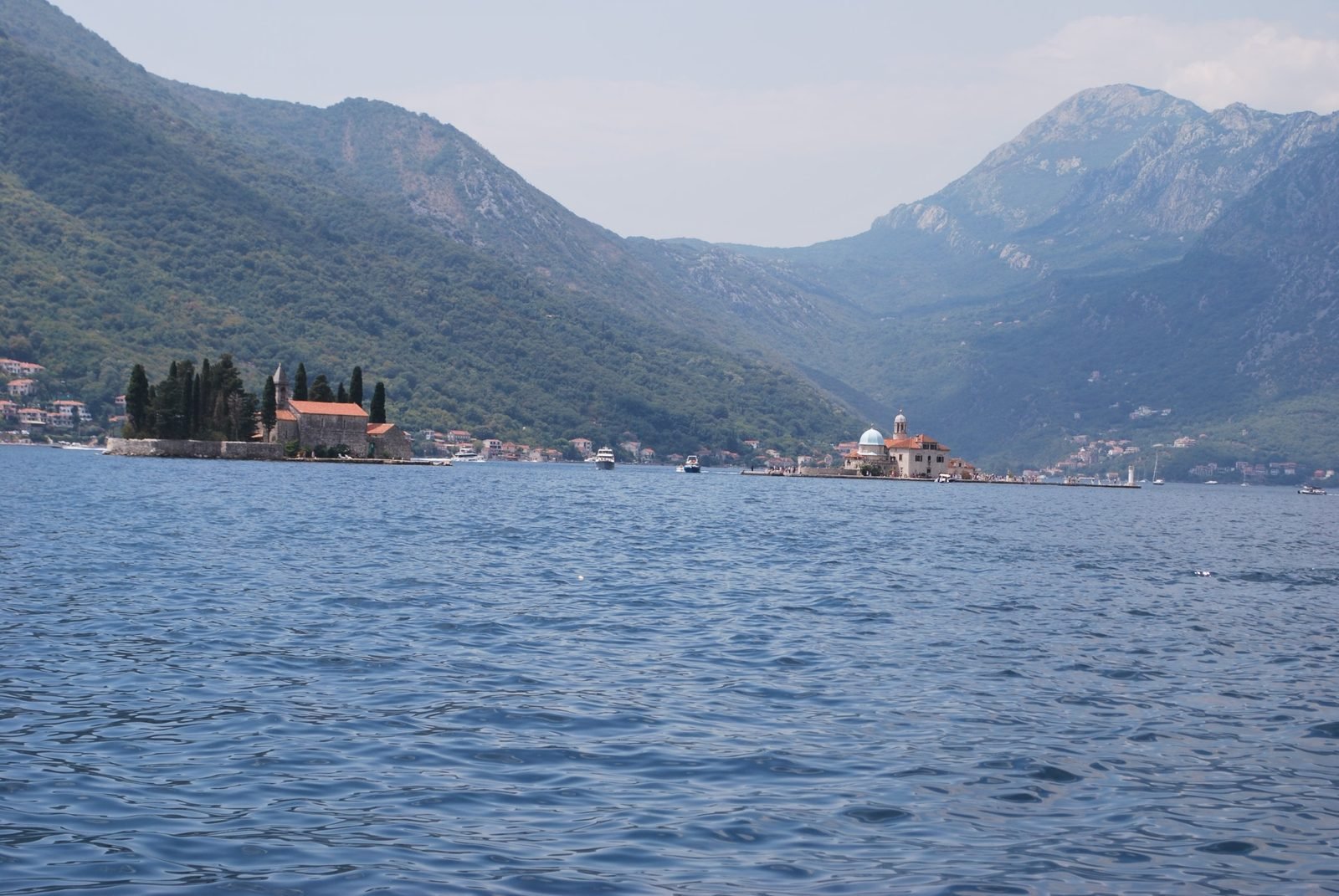
The church is the biggest building on the islet. With an adjacent museum, it hosts 68 paintings by the renowned painter from Perast, Tripo Kokolja. Among all, the famous The Death of the Holy Mary is there, a ten-metre canvas. It was ordered by Archbishop Andrija Zmajević.
Every year, according to tradition, people inhabiting and respecting Perast take part in Fašinada. It is the traditional throwing of stones on the islet where the church is. Symbolically they add a new layer of stone upon it. What the church collected, on the other hand, is of a more worldly significance.
It preserves an array of medals and accolades of servicemen who took from the wealth of the sea. The admiral Matija Zmajević expressed in his will that his well-deserved Order of Alexander Nevsky forever remains at the sea.
By tradition, the sea bears a distinct wreath, commemorated in Perast. On the islet, a woman of dignity and loyalty wove a wreath of her hair. Every year, its men commemorate erecting the islet. What the church remembers is a dedication of a woman from Perast who gifted the church that very wreath.
The last flag of Venice
In Venice, Perast was considered fedelissima gonfaloniera — the most loyal of all flag bearers. When the Venetian republic fell in 1797, the very last Venetian lion that was flying months after the decline was in Perast. Servicemen and people of dignity finally, at the sunset of the 18th century, met the norm they swore to respect. Symbolically, they buried it under the Church of St. Nicholas in their town. The state they swore allegiance to dissolved. By treaty, it was written out of power and existence. In Perast, the norm took another course. No written paper instructed where allegiance lay. It was given to the soil that made them go to the sea.
In context
Steep mountains meet the placid water in Kotor Bay. Gelcich wrote that two maritime communities held autonomy, risen from the sea.
In Kotor, the inner coherence grew behind the walls. In Perast, exposure to the sea helped it outlive every state that ruled it.
According to Gelcich, Perast parted ways with Kotor in 1365. Its linear slope predestined the exposure to the sea.
Venice fell in 1797. Months after the fall, Perast still held the flag written out of existence. Subsequently, the Venetian lion gave way to Austrian uniforms.
As steamships replaced sails, Perast declined. In the 19th century, the Slavic hinterland that had always lain behind stepped in. Petar II Petrović-Njegoš, ruler of Montenegro and a poet, used the Balović palace as a summer residence. When the first Yugoslav state was formed in 1918, Perast entered it with its architecture and maritime past.
The Kingdom of Yugoslavia recognized the significance, but did not develop it. Under socialist Yugoslavia, Perast was framed as a heritage town.
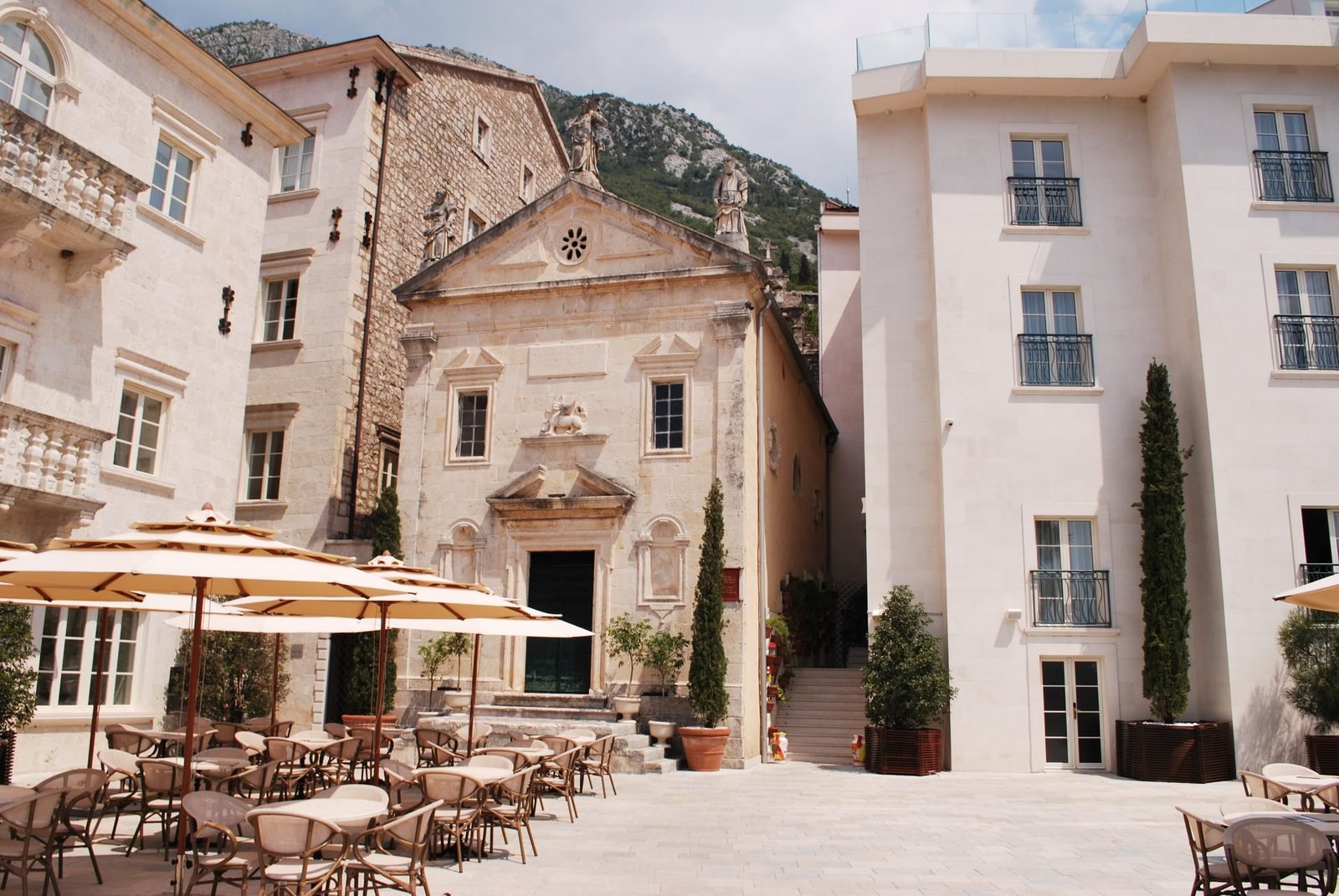
Today, Perast shares with Kotor the state they both belong to, the phenomena of depopulation and mass tourism, and protection by UNESCO. What the past produced — palaces, feasts, churches — today is kept as heritage, tourist projects or turned into units for living or sale.
A foreign standard of luxury came in. The Heritage Grand Perast by Rixos sits in the palace of the Smekja family, whose merit turned into noble status, recognized in Venice. The old Bujović Palace hosts the Museum of Perast.
Significance and dispute
To understand Perast, one must read its continuity of achievements.
What is seen today is depicted under the eyes of people who lived and served in Perast — stone that was put in their palaces, the reason for the specific structure of the palace, its position on the linear thread, the church on the water.
A linear array of achievements, won negotiations and maritime mastery face the mountains rising from the sea. Today, the town is legible to one who is ready to observe its layeredness and extraordinary concentration of knowledge and boldness in a miniature community. For centuries, Perast commanded the Strait of Verige, sailed the seas of the world and fascinated foreign courts.
What Perast sustained is that a decision on boldness, allegiance and its own architecture was made in Perast. When judgement came from the outside, the stone turned into stillness. Hardly can the appreciation of cultural heritage depict the virtue of self-initiative and boldness of people who built and protected Perast. How the norms were formed, we cannot fully know. Who ruled Perast and left it to sustain itself, Perast remained loyal when it was, by treaty, signed out of existence. Perast of its captains and seamen did not decline through a treaty, a historic change or a revolution. It changed when it was judged from beyond.
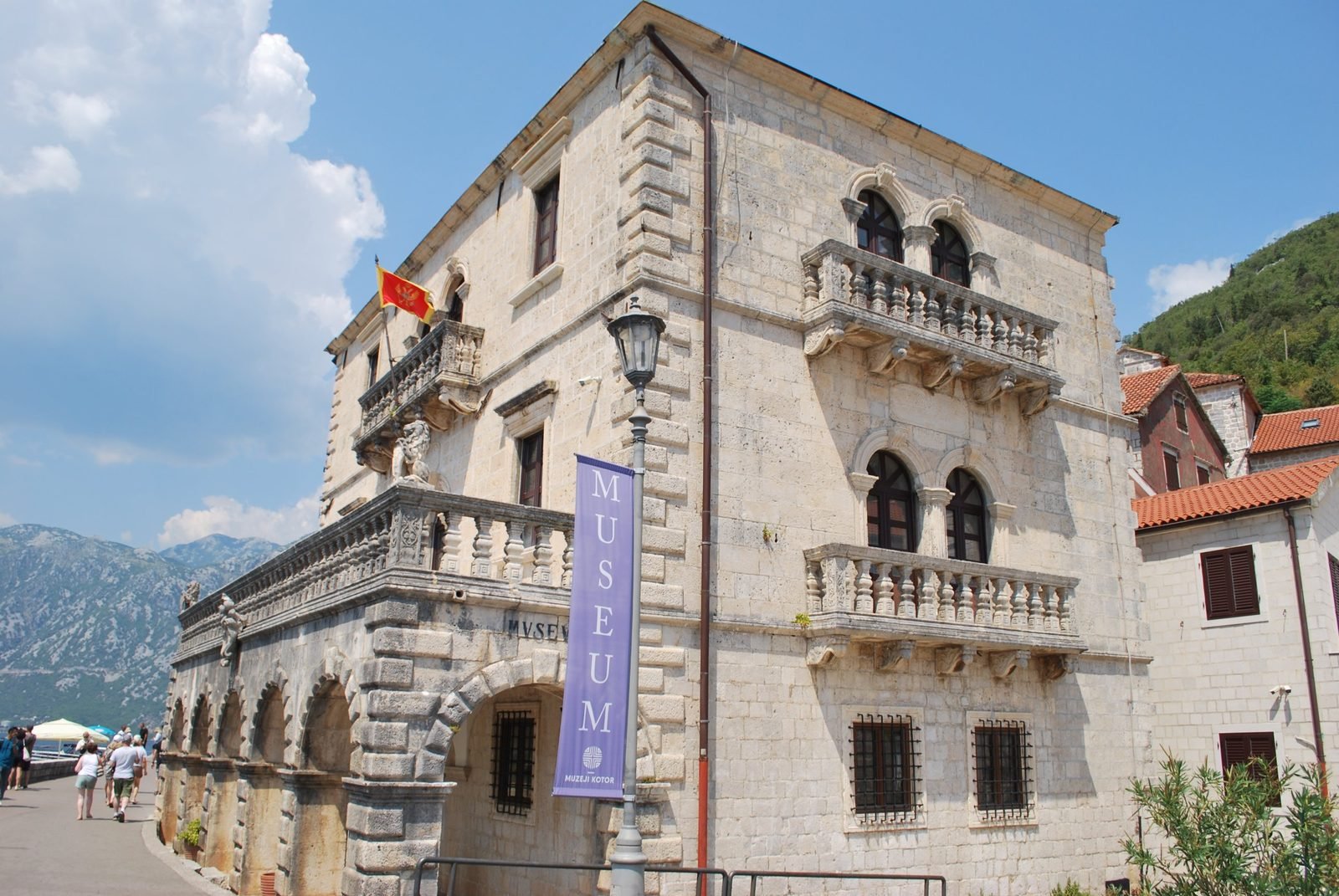
The tradition of sea captains did not decline after the fall of Venice. It started losing its sea as sails were receding from use. With Yugoslavia, Perast needed to reconsider its purpose. By then, Perast of its captains of the 17th and 18th centuries had already been for a century past. Formally, the ownership over palaces and stone remained untouched, but the 20th century was slowly gaining ground. Visitors started arriving.
Socialist Yugoslavia nationalized several of the palaces in Perast.
In another instance of the matter, successors of one of the oldest families from Perast, the Visković family, signed in 1970 with the Municipality of Kotor a contract on preservation of the traditional family palace. Till the devastating earthquake of 1979, the family museum, supported by the Municipality, was open to the public. Subsequently, the movable heritage displayed in the Palace was transferred to the Museum. The projects to reconstruct it are not completed yet.
The maritime strength did not turn into nothingness and decay; it eventually declined in its purpose. And palaces became private properties, hotels and a museum.
The luxury side of Perast tries to explain the old Perast. The latter one seeks legibility, and a guarantee to thrive in memory.
Today, a procession of tourists replaced a succession of ships that were leaving and returning to their town. The streets of the town are used for what they are not built for. When the crowd recedes, the stone remains still. In Perast, stone was made to enter the sea.